ComB vs. Habit Reversal Training (HRT): What's the Difference?
“HRT emphasizes behavioral techniques, while ComB provides a structured framework for understanding why the behavior occurs. In practice, well-delivered versions of both may lead to very similar treatment plans.”
Habit Reversal Training (HRT) and the Comprehensive Behavioral Model (ComB) are the two established behavioral approaches used to treat body-focused repetitive behaviors (BFRBs), including hair pulling (trichotillomania) and skin picking (excoriation disorder) (Wiese et al., 2023).
Although often presented as distinct treatments, HRT and ComB share considerable similarities and can look remarkably similar in clinical practice.
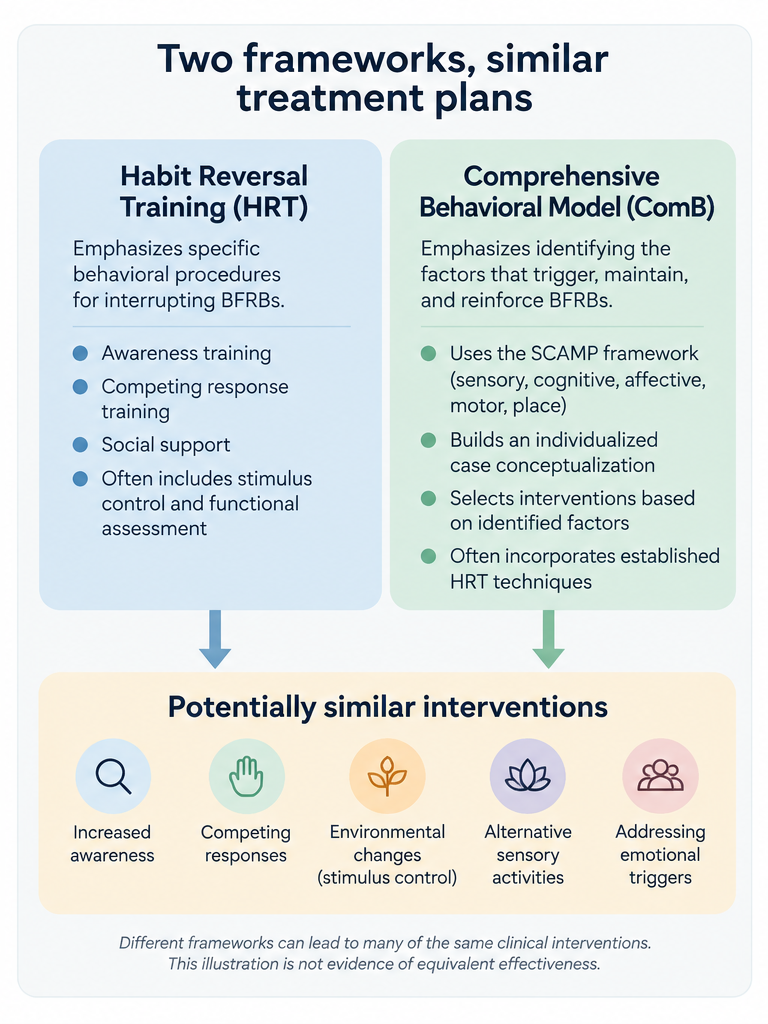
ComB provides an explicit framework for identifying the factors that contribute to BFRBs, while HRT emphasizes specific behavioral techniques for interrupting these behaviors. However, contemporary HRT also involves identifying triggers, understanding maintaining factors, and tailoring interventions to the individual.
In practice, the distinction between HRT and ComB may be less meaningful than their descriptions suggest. A clinician using either approach may identify similar maintaining factors and recommend many of the same interventions. Importantly, this overlap does not mean the two have been shown to be equally effective: there are no direct head-to-head trials comparing them.
What Is Habit Reversal Training (HRT)?
Habit Reversal Training is a well-established behavioral treatment for BFRBs and is widely considered a first-line psychotherapy (Lee et al., 2019). Its core components are:
Awareness Training: Learning to recognize when, where, and how pulling or picking occurs, including triggers, urges, and early warning signs.
Competing Response Training: Practicing an alternative behavior that is physically incompatible with pulling or picking, engaged whenever an urge or the behavior itself occurs.
Social Support: When appropriate, involving supportive people who can encourage skill use and reinforce progress.
Awareness training and competing response training are generally regarded as the most active ingredients of HRT. The original HRT package also included relaxation and contingency/positive-reinforcement stages, but it has been streamlined over time.
Stimulus control (modifying environmental conditions, routines, or other triggers to reduce opportunities for the behavior) is widely used alongside HRT, though it is often described as an adjunctive technique rather than a core HRT component (Wiese et al., 2023).
HRT is sometimes described as simply replacing pulling or picking with another behavior, but this overlooks much of what contemporary HRT involves. Clinicians also assess when and why the behavior occurs, identify relevant triggers, and tailor interventions to the individual.
What Is ComB? Understanding the SCAMP Model
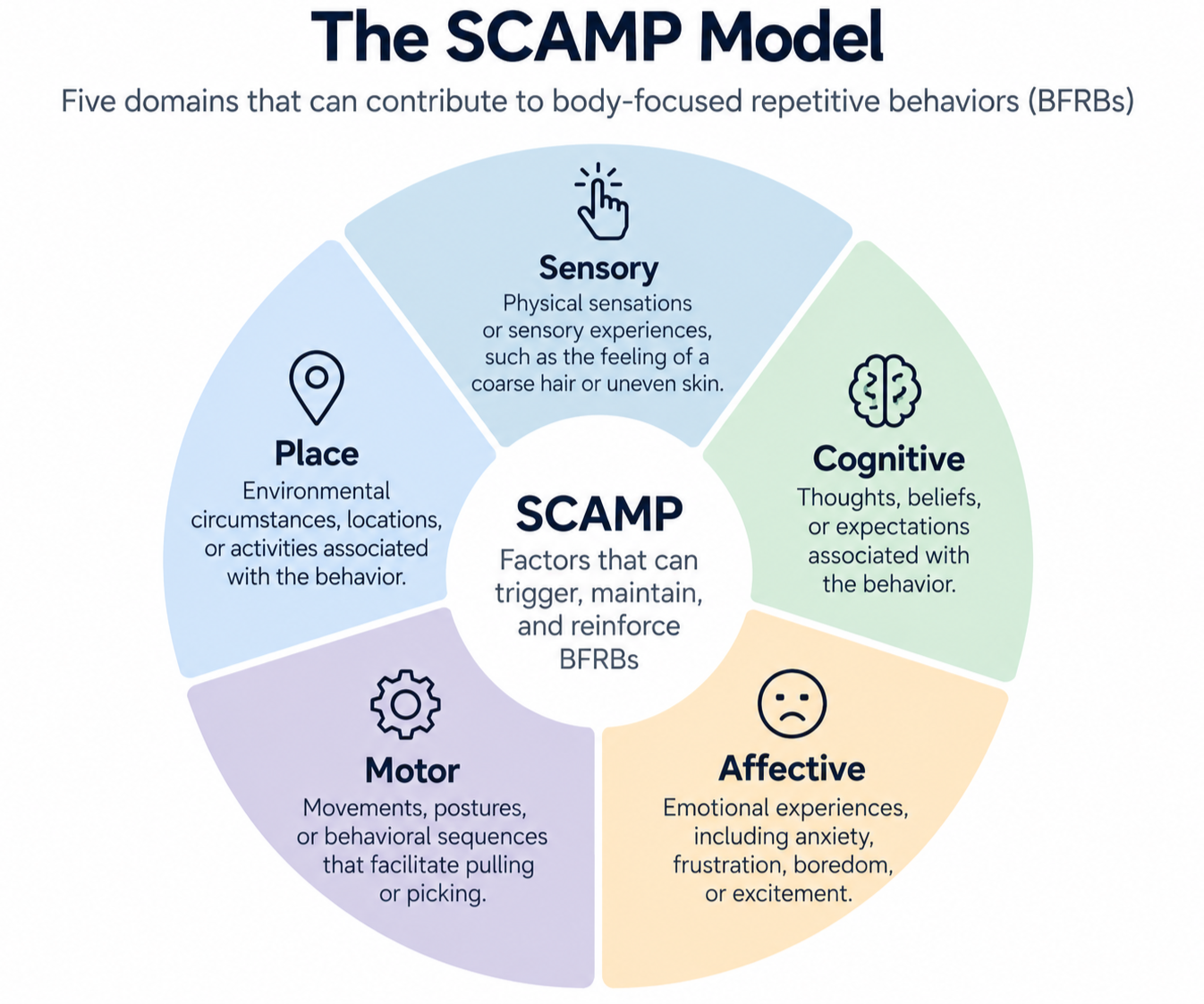
The Comprehensive Behavioral Model (ComB) emphasizes the multimodal factors that trigger, maintain, and reinforce BFRBs, and builds an individualized case conceptualization from them (Bottesi et al., 2020).
Its central assessment framework is called SCAMP, which organizes these factors into five domains:
Sensory: Physical sensations or sensory experiences, such as the feeling of a coarse hair or uneven skin.
Cognitive: Thoughts, beliefs, or expectations associated with the behavior.
Affective: Emotional experiences, including anxiety, frustration, boredom, or excitement.
Motor: Movements, postures, or behavioral sequences that facilitate pulling or picking.
Place: Environmental circumstances, locations, or activities associated with the behavior.
The SCAMP framework helps clinicians identify the factors contributing to a particular person's BFRB and select interventions accordingly.
This maps onto a distinction often drawn in the research between automatic BFRBs (performed with little awareness, often pleasurable, during relaxation or boredom) and focused BFRBs (more deliberate, typically performed in response to negative emotions such as stress or anxiety) (Szejko et al., 2025). For example, someone who pulls their hair primarily for sensory stimulation may benefit from different strategies than someone whose pulling is strongly associated with frustration or anxiety.
How Are HRT and ComB Different?
The primary distinction is one of emphasis rather than entirely different treatment techniques.
HRT is organized around specific behavioral procedures, particularly awareness training and competing response training.
ComB places greater emphasis on systematically assessing the sensory, cognitive, affective, motor, and environmental factors contributing to BFRBs and selecting interventions accordingly.
However, contemporary HRT-based treatment often incorporates functional assessment and individualized interventions, while ComB frequently draws on established HRT techniques. The result is considerable overlap. The more closely we examine how HRT and ComB are implemented in practice, the harder it becomes to identify what functionally distinguishes them when both are done well. Much of the difference may ultimately come down to terminology, rather than meaningfully different clinical interventions.
Why HRT and ComB Can Look So Similar in Practice
Consider someone who frequently pulls their hair while studying. Using the SCAMP framework, a clinician might identify several contributing factors:
Sensory: Enjoyment of finding and pulling particular hairs.
Cognitive: Thoughts about needing to find the "right" hair.
Affective: Frustration or anxiety associated with studying.
Motor: Automatically reaching toward the scalp.
Place: Sitting at a desk for extended periods.
A clinician using ComB would develop interventions targeting these factors. However, a clinician using individualized HRT might arrive at essentially the same treatment plan. Both could recommend increasing awareness of hand movements, practicing competing responses, modifying the study environment, introducing alternative sensory activities, and addressing emotional triggers.
In other words, two clinicians might use different frameworks to understand the behavior yet arrive at nearly identical treatment plans. One might describe the process in terms of SCAMP domains, while the other emphasizes awareness training, competing responses, stimulus control, and functional assessment. The labels differ, but much of what happens in treatment may be the same.
What Matters More Than the Treatment Label?
In my view, the quality of the assessment and the appropriateness of the interventions may matter more than whether treatment is labeled HRT or ComB.
A clinician who applies HRT rigidly without understanding the factors maintaining a behavior may overlook important opportunities for intervention. Conversely, a clinician who carefully identifies every SCAMP domain but fails to translate that information into practical behavioral strategies may accomplish relatively little.
Both approaches are most useful when clinicians understand the individual's behavior and develop interventions that address the factors maintaining it.
This does not mean HRT and ComB are identical or that research has established them as equally effective. They have distinct histories, treatment frameworks, and evidence bases. Nevertheless, their considerable overlap illustrates a broader issue in psychotherapy: different treatment models often share more underlying principles and techniques than their names suggest.
Ultimately, the most important question is not necessarily which model a therapist uses, but whether the treatment helps you understand and change the patterns maintaining your BFRB.
For more information about treatment, visit my pages on Body-Focused Repetitive Behaviors, Trichotillomania, and Skin-Picking Disorder.
-
Both HRT and ComB have research supporting their use in treating BFRBs, particularly trichotillomania. HRT has a longer and more extensive research history, with large effect sizes relative to control conditions across meta-analyses and large real-world samples (O'Connor et al., Journal of Clinical Psychology, 2018; Feusner et al., Journal of Clinical Psychiatry, 2026). A recent network meta-analysis identified behavioral therapy with habit reversal and ACT-enhanced habit reversal among the best-supported interventions for trichotillomania (Fisak et al., Journal of Psychiatric Research, 2026).
ComB has a smaller but growing evidence base, including a promising hair-pulling pilot and individualized single-case research (O'Connor et al., Journal of Clinical Psychology, 2018; Bottesi et al., Frontiers in Psychology, 2020).
However, there is insufficient direct comparative evidence to conclude that ComB is consistently more effective than well-delivered HRT. The approaches also share many treatment components, making it important to distinguish differences in treatment labels from differences in the interventions actually delivered.
-
Potentially, but the treatment label alone may not tell you much about what therapy will involve. More important considerations include whether your therapist:
Identifies the specific triggers and maintaining factors associated with your BFRB.
Uses evidence-based behavioral strategies, including awareness training and competing responses when appropriate.
Individualizes treatment based on your particular behavior patterns.
Monitors progress and adjusts interventions when needed.
A therapist using HRT may incorporate many principles emphasized in ComB, and a therapist using ComB may rely heavily on established HRT techniques. The important consideration is whether treatment is individualized, evidence-informed, and effective for your particular difficulties.
-
Acceptance and Commitment Therapy (ACT) is also sometimes integrated with behavioral treatments for BFRBs. ACT-enhanced behavior therapy combines techniques such as awareness training and competing responses with strategies emphasizing acceptance, psychological flexibility, and values-based action. Research supports its use for trichotillomania, with an emerging evidence base for skin picking.